
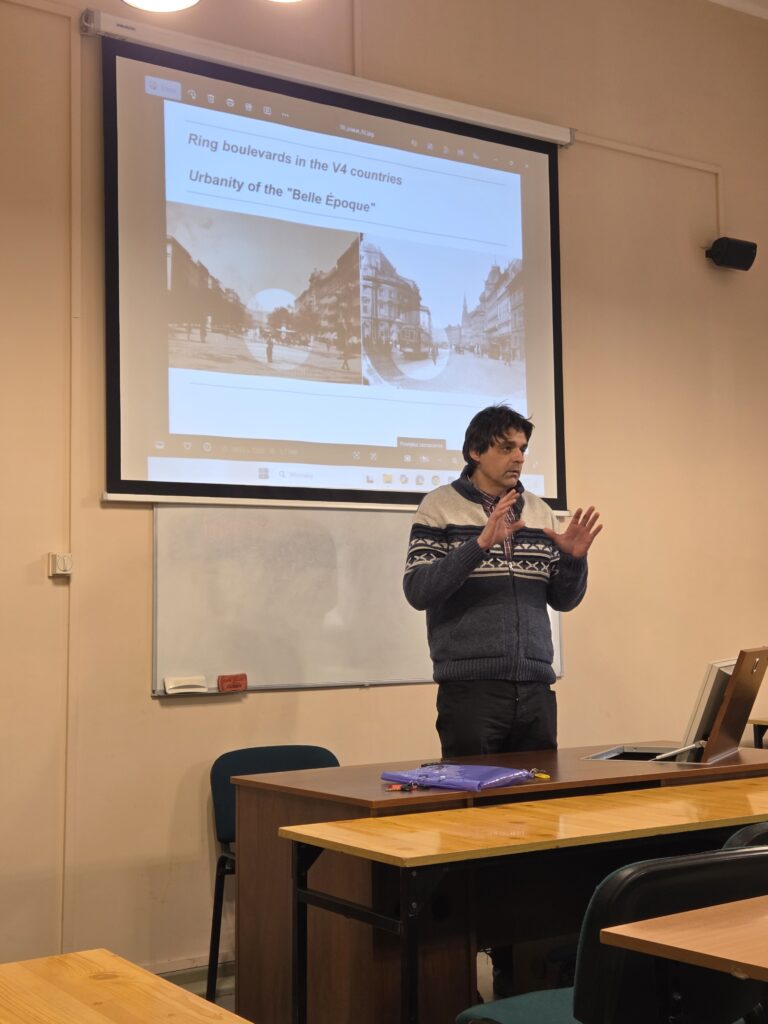
In his lecture, Máté Tamáska presented the boulevards of the Visegrád countries by comparing the differing development paths of Vienna and Budapest. Vienna, the imperial capital, was primarily renowned for its elegance, while Budapest’s Nagykörút functioned more as a major traffic artery, accompanied by a vibrant café culture. Brno largely followed Vienna’s model, whereas Szeged took Budapest as its example.
At the same time, he emphasized that these copies were far from being mere imitations. The distinctive triple structure of Brno’s boulevard and the Art Nouveau buildings along Szeged’s ring road create a unique atmosphere of their own. The same applies to Košice, although there the boulevard is today only perceptible in sections following twentieth-century transformations.
Questions raised after the lecture addressed, among other topics, the relationship between the railway and the nineteenth century—specifically whether terminal railway stations hindered or, on the contrary, facilitated the construction of the boulevards. Another important question concerned road surfaces. This topic would require further research, but it can already be noted that alongside cobblestones, asphalt—then considered a modern material—had also begun to appear during this period.