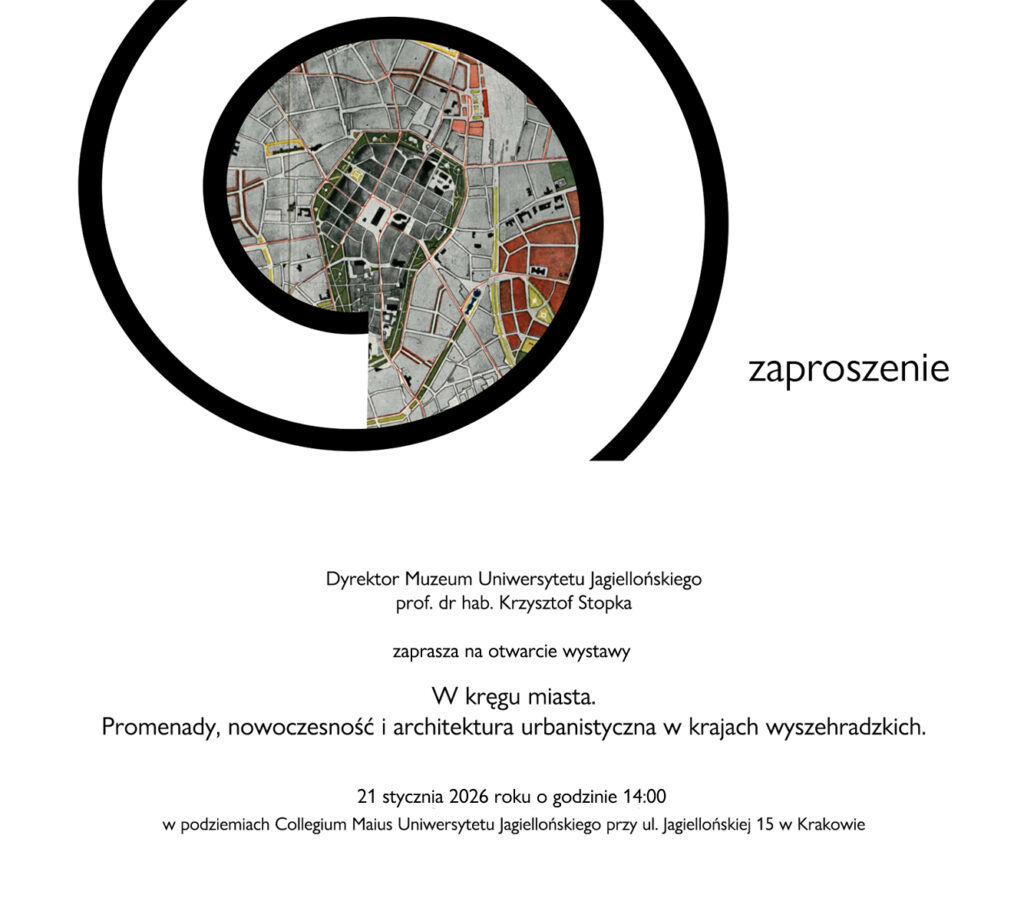
The exhibition Ring of Boulevards (Polish: W kręgu miasta. Promenady, nowoczesność i architektura urbanistyczna w krajach wyszehradzkich) opened on Wednesday, 21 January at 2:00 p.m. in Kraków, in the heart of the Old Town, within the medieval walls of the Jagiellonian University Museum at the Collegium Maius. The exhibition marks the second major stop of an international programme series led by the Hungarian National Archives and supported by the International Visegrad Fund, following its presentation in Szeged in autumn 2025.
The opening ceremony was attended by representatives of academic and cultural institutions, heads of various units of the Jagiellonian University, and members of the diplomatic corps, including Marin Gärtner, Honorary Consul of Austria in Kraków, and Tibor Gerencsér, Consul General of Hungary in Kraków.
Guests were welcomed by the host of the event, Krzysztof Stopka, Director of the Jagiellonian University Museum. The exhibition was officially opened by Piotr Jedynak, Rector of the Jagiellonian University. In his speech, the Rector presented the university as a bridging institution that supports academic, educational, and research initiatives across Central and Eastern Europe, placing particular emphasis on the importance of international cooperation within the framework of the Visegrad Fund.
Following the Rector’s address, Kamil Ruszała, curator of the exhibition and its Kraków initiator, took the floor. In his remarks, he outlined the main objectives of the exhibition, situating nineteenth-century urban development within the broader context of the Habsburg Monarchy and contemporary urban studies research. He stressed that beyond the well-known metropolitan models—such as Vienna’s Ringstrasse or Budapest’s Nagykörút—the exhibition demonstrates how medium-sized cities were also capable of developing distinctive urban solutions of their own.
Ruszała also highlighted the shared processes linking Szeged, Kraków, Brno, and Košice: the demolition of city fortifications, the creation of boulevards and promenades, and the birth of the modern city shaped by new forms of architecture, urban transport, and bourgeois life. He further emphasized the importance of presenting the results of urban historical research through exhibition projects and international collaborations, extending special thanks to the Critical Heritage Studies Hub and the staff of the Jagiellonian University Museum for their support.
Additional speakers included Máté Tamáska, the Hungarian curator of the exhibition, and Jan Sekan of the Technical University in Košice, the Slovak curator of the programme, both of whom underscored the comparative and transnational dimensions of the initiative.
The event concluded with a standing reception, offering an opportunity for informal professional and friendly discussions. The exhibition remains on view at the Jagiellonian University Museum – Collegium Maius in Kraków until the end of February.