
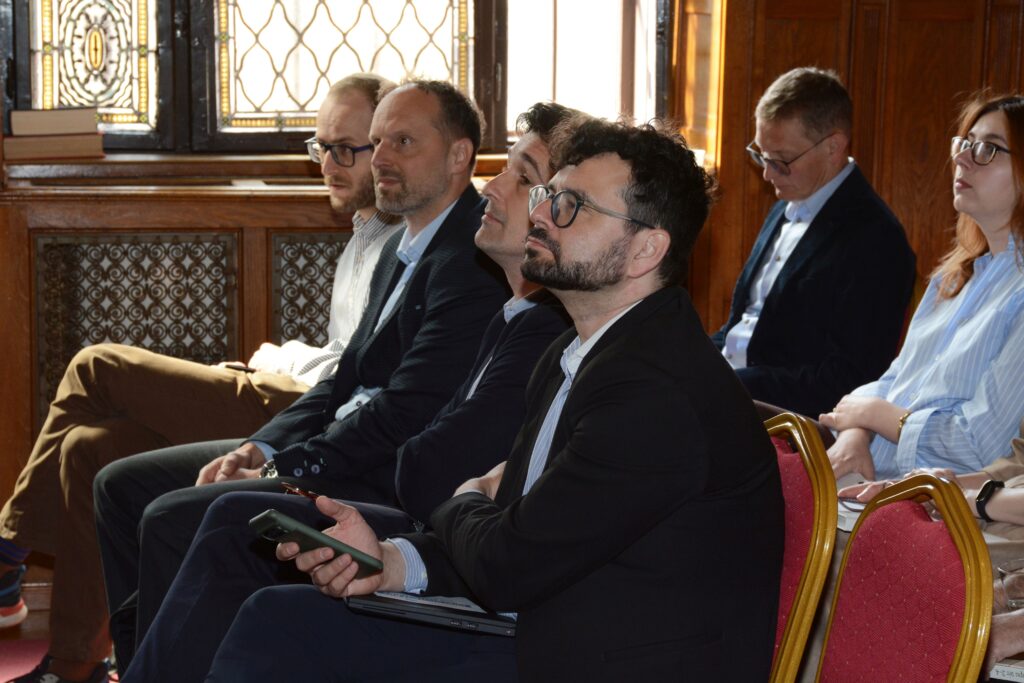
The speakers came from the Visegrád Countries and from the partner regions of V4 cooperation, so from Ukraine, Romania, Croatia and Bosnia and Herzegovina. The aim was not only to summarize the project, but also to discuss the framework of a joint scientific volume. According to the plans, the papers will be published in the series of “Studies in Modern European History” in 2027. Therefore, Csaba Szabó, the director of the Hungarian National Archives, emphasized at the opening that the project is not actually at the end, but in the middle. He expressed his joy that the archive palace on Bécsi kapu tér can host such a prestigious conference, and thanked the Visegrad Fund, which was represented by Éva Merenics.
Following the presentations, there was also an opportunity for exchange of ideas. The participants attempted to clarify the phenomenon of the ring boulevard. They concluded that the form in itself is not decisive, nor is the width of the road or the way it was built. The central essential of the ring boulevard was more the border function. In contrast to linear avenues, which create a connection between two points, the ring boulevard is more of a demarcating line between zones. The architectural design can be very diverse, from spontaneous incorporation of towns walls (e.g. Sopron) to the representative “Viennese” Ring (Lviv). From the today perspective all forms has a characteristically phenomenon. The planers of the 19th-century did not suborned the urban design to the transport issues. Healthy air, the measurement of building plots, the location of public institutions, and the attractive motifs of cityscape motivated the planners. From the beginning of the 20th century, the ring boulevard increasingly became a ring road. This idea influenced not only the new urban developing but also had an impact on using of 19th-century ring boulevards.