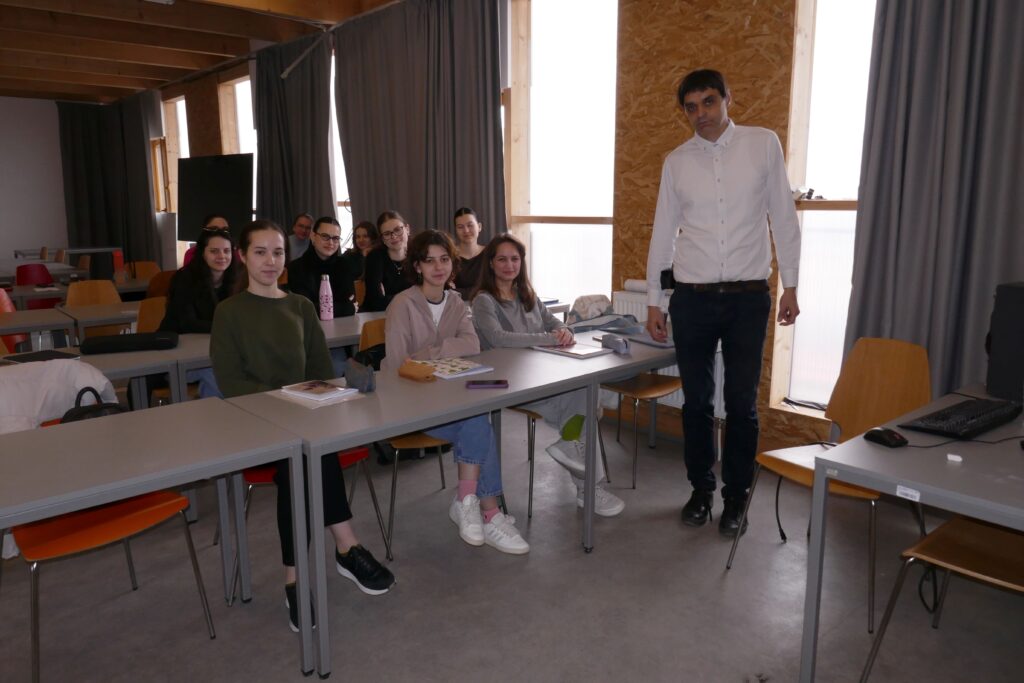
Adam Gudzek presented the history of Brno’s rig boulevard to the students. The presentation was also an example how the student can use archival sources in the urban planning. Gudzek presented many building plans, layouts and maps. Based on these, some now-forgotten debates about the boulevard are revealed, such as whether it should be built as an “open gate” or a “closed fence”? In other words: should the ring boulevard be a sharp border between the old town and the suburbs or rather a transitional space?
In his lecture, Máté Tamáska primarily presented Szeged, the city whose basic structure is most similar to the Pest side of Budapest, but which ultimately exudes a different atmosphere. He drew attention to the fact that in a sociological sense, the boulevards of Szeged were “shifted”: the small boulevard filled the social function of the inner ring: with representation and apartment buildings. While the grand boulevard of Szeged was more an outer ring, with large-scale facilities (e.g. barracks). The 20th-century ring road, near to the old flood protection embankment, is a completely different structural element. It is part of the urban planning based on prefabricated (panel) real estates.